ST Micro MPU 32F030F4P6
Gyro IC M688(099LB1L122)
2.4G Wireless Tranceiver IC XN297L


This will continue.
This will continue.


 | ||||||||||




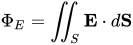
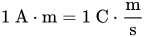
E (Electric Field Strength) and H (Magnetic Field Strength) . H may be difficult to catch for some people.
1. Equations
V (voltage)
E (Electric Field Strength) = ----------------
d (distance)
V(oltage)
The unit is ------------
m(eter)
V can be either constant or variable (in this case usually the small <v> is used.)
I (current)
H (Magnetic Field Strength) = ------------------
d (distance)
A(mpere)
The unit is -------------
m(eter)
I can be either constant or variable (in this case usually the small <i> is used)
A
----- is abstract or abstracted. Difficult to imagine.
m
tQ
I (current) is time derivative of Q (Charge) = -----
dt
and Q (charges) is supposed to move in this case, not static as V and creates magnetic field.
2. Field Concept
V
E = -----
d
When V is constant
E changes almost infinite (∞) to almost zero (0) as d changes almost zero (0) to almost infinite (∞). Reciprocal relation. The point is that E exists at every point (every where) in space.
I
H = -----
d
When H is constant
H changes almost infinite (∞) to almost zero (0) as d changes almost zero (0) to almost infinite (∞). Again reciprocal relation. The point is that H exists at every point (every where) in space.
Every where then Field Theory.
ACT
<Electronics Tutorials>some of which I recently read several times.They are good reading materials as tutorials as the name shows. At the beginning of their <Series Resonance Circuit> we can find the following mostly familiar formulas.
http://www.electronics-tutorials.ws/accircuits/series-resonance.html

sptt additional explanation and comments
The first and the second equations were already introduced at the end of Post <Reciprocal>.
"
Inductors act like resistors as XL (which is regarded as resistance) = 2πfL. On the other and Capacitors act as reciprocal of Resistors as XC (which is regarded as resistance) =
1 / 2πfC.
"
Please note that XC is a reciprocal form. So the chart becomes y = 1/x form like below.

The difference is x : 2πfC. <x> is a variable while f is variable but 2π is constant and C can be either a constant or the second variable.
<f> has the unit <(Number) / sec>. The unit of C is Farad but originally (from wiki "Farad")
"
A farad has the base SI representation of: s4 × A2 × m−2 × kg−1
It can further be expressed as:




IR = V
Therefore
ITRT = I1R1 + I2R2 + I3R3
Since IT = I1 = I2 = I3
Therefore RT = R1 + R2 + R3
Inductors act like resistors as XL (which is regarded as resistance) = 2πfL. On the other and Capacitors act as reciprocal of Resistors as XC (which is regarded as resistance) =
1 / 2πfC.
"
These two schematics are similar in terms of the arrangement - in Series, but the difference is big. We can re-arrange R-L-C Series in terms of "resistance".
------- R --- XL(2πfL) --- Xc (1/2πfC) --------
Then use the same reasoning


