I recently saw video on the discussion on Conventional Combustion Engine Car vs Electric Car EV). The commentator reports that an Electric Car uses heavy and bulky Batteries. Heaviness uses more energy to make a car moving than a Combustion Engine Car (the engine itself is lighter and smaller than the batteries used in an EV) .
Bulky means that the size of the total batteries is big and therefore the surface-area:volume ratio (SA:V)
Surface Area / Volume
is small. This means the the heat transfer from the batteries to the surrounding area is naturally limited
SA:V of a ball
The commentator the explains the difference between a small ball and big ball. Intuitively, a small ball has a small surface so heat transfer is limited. A bigger ball has a big surface and heat transfer is better. But this is completely wrong. The chart below shoes a dramatic change as the radius becomes smaller and smaller.
Wiki
For solid spheres

A solid sphere or ball is a three-dimensional object, being the solid figure bounded by a sphere. (In geometry, the term sphere properly refers only to the surface, so a sphere thus lacks volume in this context.)
For an ordinary three-dimensional ball, the SA:V can be
calculated using the standard equations for the surface and volume,
which are, respectively, 
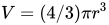
The commentator says
are the secondary school math.
But to get these you need high school math - integration.
SA / V = 4𝝅 r x r / (4/3) 𝝅 r x r x r = 3 / r
So when r = 1
SA / V = 3 you can see this in the above chart
So when r = 0.1
SA / V = 30 Cannot see this in the chart.
So when r =10
SA / V = 0.3 you can see this in the above chart
So when r =100
SA / V = 0.03 Difficult to see this in the above chart
SA:V of a Cube
it is easy.
SA = 2(a x a) + 2(a x a) + 2(a x a) = 6 (a x a)
V = a x a x a
SA / V = 6 (a x a) / (a x a x a ) = 6 / a
when a = 1
SA / V = 6
when a = 0.1
SA / V = 60 - large
when a = 10
SA / V = 0.6
SA:V of a shoes box (a common box)
A rectangular cuboid, a common box has length 


- its volume is the product of the rectangular area and its height:
- its surface area is the sum of the area of all faces:


Many Electronic parts have this shape. length
In case length a = 2, width b = 1 , height c = 0.5
SA / V = 2 (2 + 1 + 0.5) / 2 x 1 x 0.5 = 7 / 1 = 7
In case length a = 1, width b = 0.5 , height c = 0.25
SA / V = 2 (1+ 0.5 + 0.25) / 1 x 0.5 x 0.25 = 3.5 / 0.125 = 28 - large
In case length a = 4, width b = 2 , height c = 1
SA / V = 2 (4 + 2 + 1) / 4 x 2 x 1 = 14 / 8 = 1.75
sptt
