Thursday, July 23, 2020

Reciprocal - 3 (Taylor Series)


Reciprocal is somehow anti-intuitive. y = x is a very simple function, a simple straight line but its reciprocal : y = 1/x is not simple at all as shown below.


Apart from Electronics, I am recently re-studying "Taylor Series", which I studied before but highly likely did not understand it (as I do no remember what it is). In Wiki "Taylor Series" I found the following.

"
Definition
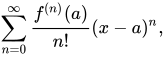
The Taylor series of a real or complex-valued function f (x) that is infinitely differentiable at a real or complex number a is the power series

{\displaystyle f(a)+{\frac {f'(a)}{1!}}(x-a)+{\frac {f''(a)}{2!}}(x-a)^{2}+{\frac {f'''(a)}{3!}}(x-a)^{3}+\cdots ,}
where n! denotes the factorial of n. In the more compact sigma notation, this can be written as
{\displaystyle \sum _{n=0}^{\infty }{\frac {f^{(n)}(a)}{n!}}(x-a)^{n},}
where f(n)(a) denotes the nth derivative of f evaluated at the point a. (The derivative of order zero of f is defined to be f itself and (xa)0 and 0! are both defined to be 1.)
When a = 0, the series is also called a Maclaurin series.[1]

"

Probably few people know the deep meaning (if it has).

Point 1)

{\displaystyle \sum _{n=0}^{\infty }{\frac {f^{(n)}(a)}{n!}}(x-a)^{n},}
where f(n)(a) denotes the nth derivative of f evaluated at the point a.a>is a certain x value but 
                                                                                                           n
related with f(a), of which derivatives becomes the coefficient of (x - a).  Also </n!>is necessary.

And (xa)0 and 0! are both defined to be 1. - This is important but do not appear in the formula.

Probably few people know the deep meaning (if it has).


Point 2) 

(x - a) is the difference between x - a or distance between x and a. It may be close or may be far away. If x = a, (x - a) = 0. Taylor Series becomes 0 no matter what the front "Derivative Coefficient " and  /n!are or Non sense! So should not be x = a.

(x - a) can be negative.

(-1) =(-1)

     2
(-1) = (+1)

     3
(-1) = (-1)

     4
(-1) = (+1)


Point 3)

It is clear that Taylor Series is closely related with the following "modern" definition of derivative (differentiation).

Wiki

This limit is defined to be the derivative of the function f at a:
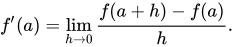
f'(a)=\lim _{h\to 0}{\frac {f(a+h)-f(a)}{h}}.

Deep or hidden (if hidden) meaning it shows as both using <limit>.

Point 4)
 
Taylor Series is in general not used for the purpose of finding the function of f(x), but to show the already known f(x) in a Power Series form. So we may be able to call it Taylor (Series) Transform as well, like Fourier Series / Transform. f(x) in Taylor Series form may have some uses to deal with 
function f(x).

 
Let's go on with examples.

 
f (x) =

 
f (x)' = 1
f (x)'' = 0

 
When a = 0

                  
1                    0               2
f (x) = 0 + ----- (x - 0) + ------- (x – 0) = x
                  
1                    2
 

When a = 1

                  
1                        0              2
f (x) = 1 + ----- (x – 1)   + ------- (x – 1) = x

                   1                        2


When a = 10

                      1                        
0                2
f (x) = 10 + ----- (x – 10)  + ------- (x – 10)   =  x
                    
1                          2


When a = - 2

                    
1                     0            2
f (x) = -2 + ----- (x + 2) + ------ (x + 2)    =   x
                    
1                    2


-----


Examples from Wiki.


Examples

The Taylor series for any polynomial is the polynomial itself. 

The Maclaurin series for 1/(1 − x) is the geometric series. 

{\displaystyle 1+x+x^{2}+x^{3}+\cdots ,}
so the Taylor series for 1/x at a = 1 is
{\displaystyle 1-(x-1)+(x-1)^{2}-(x-1)^{3}+\cdots .}


This is our simple interest. Why so? Simply change <x - 1> to x in 

 
          2     3      4
1 + (1 - x) + (1 - x) + (1 - x) + (1 - x) .....

                               2            2                       2         2

= 1 - (x - 1) + (x - 1) + (1 - x)((x - 1) + (x - 1)(x - 1)  .....

            2     2         4

= 1 - (x - 1) + (x - 1) - (x - 1)(x - 1) + (x - 1) ....

            2     3     4

= 1 - (x - 1) + (x - 1) - (x - 1) + (x - 1)


Copy -> paste does not work well here so I did some modification (the original meaning remains unchanged)


The Maclaurin series for 11 − x .

This part reads in Wiki

                                     1                  -1

The Maclaurin series for -------  or (1 - x)
                                          1- x 


    1                                             1
--------  seems quite similar to  ------  but the actual behavior seems quite differs.
 1 - x                                           x


When x = 0  the value is 1. 

                                         1
When x = 1 the value is -----, which does not exists or does not make sense.
                                         0

When x is in between 0 and 1,

x = 0 the value is 1.

x = 1/1000 or 0.001 the value is 1000/999 or 1.001001001 .... - almost 1.0
x = 1/100 or 0.01 the value is 100/99 or 1.010101.... - still almost 1.0
x = 1/10 or 0.1 the value is 10/9 or 1.11111....
x = 1/4 or 0.25 the value is 4/3 or 1.3333.....
x = 1/2 or 0.5 the value is 2
x = 3/4 or 0.75, the value is 4
x = 9/10 or 0.9 the value is 10
x = 99/100 or 0.99 the value is 100
x = 999/1000 or 0.990 the value is 1000

seems going to ∞ as x approaches to 1.


In case of more than 1 (dramatic change)


x = 1001/1000 or 1.001, the value is -1000

x = 101/100 or 1.01, the value is -100
x = 11/10 or 1.1, the value is -10
x = 3/2, the value is -2
x = 2, the value is -1
x = 3, the value is – ½
x = 10, the value is – 1/9
x = 100, the value is – 1/99
x = 1000, the values is – 1/999

seems closing to 0 as x goes on to +∞ while goes down to - ∞ as x approaches to 1.


While when x is negative,

x = -1/1000 the value is 1/1.001 or 0.9999..... or almost 1.0

x = -1/100 the value is 1/1.01 or 0.990000099..... or still almost 1.0
x = -1/10 the value is 1/1.1 or 0.90909090..... or almost 0.91
x = -1/4 the value is 4/5 or 0.8
x = -1/2 the value is 2/3 or 0.666666...
x = -3/4 the value is 4/7 or 0.5714285...
x = -9/10 the value is 10/19 or 0.526315
x = -1 the value is 1/2 or 0.5
x = -2 the value is 1/3
x = -10 the value is 1/9
x = -100 the value is 1/999
x = -1000 the value is 1/999 or 0.001001001.... almost 0

seems closing to 0 as x goes on to - ∞ .


                    1                                    1
Actually -------- is quite similar to ------ .
                1 – x                                   x

Look at the chart at the top.


x changes to -x, which means the x positive number becomes all negative while all negative numbers become positive. To make the two charts reflect along the y-axis. Then move these two charts horizontally by <1> to the right.  I cannot find the exact char of this. I found the following chart on the net. Please move the chart of


            1
y = - ---- horizontally by <1> to the right.
             x

1_6.png


https://www.yaklass.ru/p/algebra/8-klass/kvadratichnaia-funktciia-funktciia-y-k-x-11012/funktciia-y-k-x-ee-svoistva-i-grafik-9599/re-8a7d95fe-3694-42ed-973e-b5e769a7178d


Another chart I found on the net is similar but not exact either.
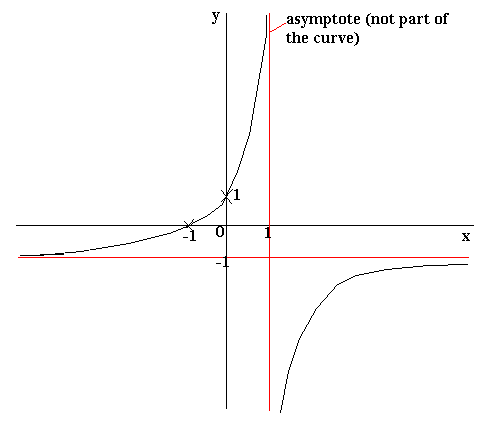

Curve Sketching - Mathematics A-Level Revision
 https://revisionmaths.com/advanced-level-maths-revision/pure-maths/geometry/curve-sketching

                                       1 + x
This is  the chart of y =  --------
                                      1 - x

when x = 2

       1 + 2
y = ----------  = - 3
       1 - 2

when x =3

       1 + 3
y = ----------  = - 2
       1 - 3

Differentiation is complicated but possible - Differentiation of quotient "quotient Rule".

Wiki

"
Let {\displaystyle f(x)=g(x)/h(x),} where both g and h are differentiable and {\displaystyle h(x)\neq 0.} The quotient rule states that the derivative of f(x) is

f'(x) = \frac{g'(x)h(x) - g(x)h'(x)}{[h(x)]^2}.
"


         1 + x
y =   --------
         1 - x

           1 (1-x) - (1+x)(-1)        1 - x +1 + x              2
y' =  ------------------------  =  ---------------  =  ----------------
            (1 - x) ^ 2                    (1 - x) ^ 2          (1 - x) ^ 2


At x being 0 the derivatives is 2.
At x being 2 the derivatives is also 2.

The slope of f(x) at x = 0 and 2.
You can see these on the chart. These correspond with chart.

But the other parts how to explain the relation between the equation and the chart ? We can guess the the charts move horizontally by <+1>or to the right and vertically by <-1> or downward.

         1 + x
y =   --------
         1 - x

Modifying


                1 + x            1 + x +1 - x             2
y + 1  =   -------- +1 = -----------------   = ---------
                1 - x               1 - x                  1 - x


          2
y = --------   - 1
       1  -  x

                                                         2
This means vertically shifting  y = -------- downward by -1.
                                                      1 - x                     

We have already seen shifting horizontally to the right by 1.


Back to Wiki

                                                              -1
The Maclaurin series for 11 − x = (1- x)

Wiki does not give any explanation. The latter form is used for differentiation use - and we must use 'chin rule"

                     -1
f (x) =  (1- x)         

                        -2     
f (x) '  = -1(1 - x)  (-1) .       (-1)  comes from the differentiating (1 - x) ->  (1 - x) '  - as here required to use "chin rule"

                       -2
          =  (1 - x)

when x = 0 , it becomes 1

                        -3     
             -2(1 - x)     
f (x) ''  = ---------   (-1)
               2!

when x = 0 , it becomes 1

                         -4     
                - 6(1 - x)   
f (x) '''  =  --------   (-1) 
                 3!

when x = 0 , it becomes 1

                            -5     
                - 24(1 - x)
f (x) ''''  = -----------    (-1) 
                  4!

when x = 0 , it becomes 1

This process continues. Back to

{\displaystyle f(a)+{\frac {f'(a)}{1!}}(x-a)+{\frac {f''(a)}{2!}}(x-a)^{2}+{\frac {f'''(a)}{3!}}(x-a)^{3}+\cdots ,}
and

The Maclaurin series for 11 − x is the geometric series

{\displaystyle 1+x+x^{2}+x^{3}+\cdots ,}


Our calculation above, a = 0. Please note

"
where f(n)(a) denotes the nth derivative of f evaluated at the point a.
"

which means

where f(n)(a) denotes the nth derivative of f (x) evaluated at the point x = a.  So in this case at x = a = 0

f (0) =1
f (0)' = 1
f (0)'' = 1
f (0)''' = 1
f (0)'''' = 1
.
.
.

So

The Maclaurin series for 11 − x is the geometric series

{\displaystyle 1+x+x^{2}+x^{3}+\cdots ,}

                                              1
Then when we put x = 0 in  ------
                                             1- x

   1
------  = 1
1 - 0

{\displaystyle 1+x+x^{2}+x^{3}+\cdots ,}  = 1   (x = 0)


Fine.


When we put x = 1/2

    1
---------  =  2
1 - (1/2)

1 + 1/2(=0.5)  + 1/4 (=0.25) + 1/8 (=0.125) + 1/16 (=0.0625) + 1/32(=0.03125) + 1/ 64 (=0.0156) + = 1.98435 + -->  2.0

Fine again.

 When we put x = 1

      1                1
   -------   =    -----
   1 - 1              0

While
1 + 1+ 1+ 1+1+ 1+ ........  = .  This may be correct as

when we put x -> 1


      1                          1
   -------------  =    ----------    = .  This may be correct.
   1 - x ->1        ->0

When we put x = -1/2

      1               2
   -------   =    -----  = 0.66666
   1 - (-1/2)     3

                          2         3            4          5
1+ (-1/2) + (-1/2)+ (-1/2)+ (-1/2) + (-1/2) + ......

= 1 - 0.5 + 0.25 - 0.125 + 0.0625 - 0.03125

= 0.65652

Fine again.


 When we put x = -1

      1                1
   -------   =    -----
   1 - (-1)          2


While  

                     2      3       4         5
1+ (-1) + (-1) + (-1)+ (-1) + (-1) + ......


                                                                                   0 + 1           1
= 1 -1 +1 -1 + 1 -1 + .....  = 0 or 1/2 or 1 ?  May be --------- =  ------
                                                                                     2               2

Again almost fine.
                                          9
How about x = - 0.9 or -  ------
                                         10

       1                          1             10
   ---------------  =     ------    =  ------- = 0.5263158
   1 - (- 9/10)           19/10         19


                         2           3          4           5             6           7            8            9          10
 1+ (-0.9) + (-0.9) + (-0.9)+ (-0.9) + (-0.9) + (-0.9) + (-0.9) + (-.0.9) + (-0.9) + (-0.9) ......

= 1 - 0.9 + 0.81 - 0.729 + 0.6561 - 0.59049 + 0.531441 - 0.4782969 + 0.43046721 - 0.387420489 +

0.2486784401

= 0.5914792611

If we continue we will approach 0.5263158, probably. So almost fine.


                                                                     99
One more step. How about x = - 0.99 or -  ------  ?
                                                                   100

       1                             1               100
   ------------------  =   --------    =  ------- = 0.50251256
   1 - (- 99/100)         199/100        199


                                2             3            4             5             6             7       
 1+ (-0.99) + (-0.99) + (-0.99)+ (-0.99) + (-0.99) + (-0.99) + (-0.99)

              8              9            10
 + (-.0.99) + (-0.99) + (-0.99) ......

= 1 - 0.99 + 0.9801 - 0.970299 + 0.96059601 - 0.9509900499 + 0.9414801494 - 0.9320653479 + 0.92274469442 - 0.91351723747 + 0.90438207499

This is roughly

= 1 - 0.99 + 0.98 - 0.97 +0.96 - 0.95 + 0.94 - 0.93 + 0.92 - 0.91 + 0.90

= 0.95 

and
                                                                                                                           11
= 1 - 0.99 + 0.98 - 0.97 +0.96 - 0.95 + 0.94 - 0.93 + 0.92 - 0.91 + 0.90 - (-0.99)  (= - 0.89533825424, roughly = - 0.895)

= 0.055

If we continue and continue and further continue it may converge to 0.50251256  probably as (095 +0.055) /2  = 5.025.

----------


It is not very intuitive to get

11 − x  = {\displaystyle 1+x+x^{2}+x^{3}+\cdots ,}

                        -2     
f (x) '  = -1(1 - x)     (-1) 

                        -2           1
          =  (1 - x)      =  ----------
                                            2
                                  ( 1 - x)

and

f(x) = {\displaystyle 1+x+x^{2}+x^{3}+\cdots ,}  

                                    2       3      4     
f ( x) ' = 0 + 1 + 2x + 3x + 4x + 5x  +  

are identical.

Furthermore the relation is not always correct either.

If x is more than 1 (excluding) , say x = 2

      1
   -------  =  -1
  1 - 2 

While

1 + 2 + 4 + 8 + 16 ...... is definitely not - 1.


Say x = 1.5 or 3/2

   1                1
 -------  =  -------   = - 2
1 - (3/2)     -1/2


1 -2 +4 - 8 + 16 - 32 + 64 + ......   ?  - highly unlikely becomes -2 

Say x = 1.01 or 101/100

      1                       1
 -------------  =   ---------  =  - 100
1 - (101/100)       -1/100
                                  
1 - 101/100 (=1.01) + 10201/10000(=1.0201) - 1,030,301/1,000,000(=1.030301) + 104,060,410/ 100,000,000(=1.04060) -

= 1.020399


Say x = 1.1 or 11/10

      1                       1
 -------------  =   ---------  =  -10
1 - (11/10)          - 1/10

while

1  + 1.1 + 1.21  + 1.331 + 1.4641+ .....


This relation can stand only a certain limited x value range, not an universal rule. Then which range ?
Probably <-1 - +1> by the above calculation of several representatives.


Next, back to Wiki

"

so the Taylor series for 1x at a = 1 is

{\displaystyle 1-(x-1)+(x-1)^{2}-(x-1)^{3}+\cdots .}
"

This should be

so the Taylor series for y or f (x) = 1x at a = 1 is

y or f (x= {\displaystyle 1-(x-1)+(x-1)^{2}-(x-1)^{3}+\cdots .}


if explained the process
     
        1        -1
y =  ---  =  x    = 1/1 = 1  (when x =1, which is a)
        x

            -2
y' = -1     =  -1 (when x = 1)

The first derivative of y = 1/x  at x = 1 is -1 guessing from the chart.

           -3
y'' = 2x    = 2 (when x = 1)

             -4
y''' = -6x    = -6 (when x = 1)

.
.
.

                                          2                  3          
y (f (x)) =  1  - 1 (x - 1) + 2(x - 1)/2! - 6 (x - 1)/3! . . . .


= {\displaystyle 1-(x-1)+(x-1)^{2}-(x-1)^{3}+\cdots .}


Then when x =1

       1
y = ---- = 1
       1 


while

= {\displaystyle 1-(x-1)+(x-1)^{2}-(x-1)^{3}+\cdots .}

becomes
                            2        3
= 1 - (1-1) + (1-1) - (1-1) .....  = 1


Then when x =2

       1
y = ----
       2

= {\displaystyle 1-(x-1)+(x-1)^{2}-(x-1)^{3}+\cdots .}

becomes
                            2        3         4
= 1 - (2 - 1) + (2 - 1) - (2 - 1) +(2 - 1) ..... 

= 1 -1 +1 -1 + 1 .......   = 1 or 0 or 1/2


Then when x =3

       1
y = ----
       3

= {\displaystyle 1-(x-1)+(x-1)^{2}-(x-1)^{3}+\cdots .}

becomes
                            2         3          4
= 1 - (3 - 1) + (3 - 1) - ( 3- 1) + ( 3- 1) ..... 

= 1 -2 +4 - 8 + 16 - 32 + 64 .......   = ?


ACT

Monday, June 15, 2020

China Made Portable Fan - 2


Basic spec shown on the label attached to the product:

Input Voltage: DC 5V
Output Voltage: DC 5V - 9V
Input Current: 0.5A -1A
Output Power: 4W (Max?)
Battery Type: Li-ion 18650
Battery Voltage: 3.7V

I purchased this fan 2-3 years ago. It does works due to some problem. No brand or so called Generic China made. The shape is common. A bit too large for my (man) one hand to keep holding it. Three step motor (peed) control 3 - 2 - 1 (strongest wind).

On PCB Board

U1 - 14 pin IC - no marking. For motor operation and control, plus some other functions.
U2 - DW01 - Battery protection IC
U3 - 4056 - Battery charging IC
U4 - AL462 (not identified). 6P IC. As located colsoe to Coil 4.7uH it may be Up-Converter IC.
Q1 - AOLA (not identified) Maybe MOSFET N-Chanel2300 or similar one
Q2- 2301-P MOSFET (P-Channel) (*). N-Channel is 2300 (see the previous Post)
Q3 - J3Y marking for Transistor S8050.
Q4 - no part found on PCB (skipped for some reason)
D1, D4 - SS34 (Schottkey)
LED 2, 4, 5, 6, 7, 8
L2 - 4.7uH

----ー
U2 - DW01
U3 - 4056
Q1 - AOLA (not identified). Maybe MOSFET N-Chanel 2300 or similar one
Q2- 2301-P MOSFET (P-Channel) (*)
D1, D4 - SS34 (Schottkey)
L2 - 4.7uH

These are used also in the fan I reported (China Made Portable Fan)

----ー
Motor

I do not know what kind of  motor this.

It has a outer magnet ring covered by metal
Horizontal Four Big Coils
Then at the center a spinning shaft which is fixed to the center of the fan with four blades (not seen in this photo).
One Hall Sensor (not seen in the photo, easily broken later when tried to move)

----ー

(*) There are so many suppliers of this part.

NX2301P  Nexperia
ST2301A   Stanton
SQ2301ES  Vishay
SSM2301N  Silicon
AFP2301A Alfa MOS
AM2301PE  Analog Power
MSP2301N3  Bruckewell
STP2301  Stemtron
TSM2301B   Taiwan Semiconductor
TP2301PR  Tiptech
CHT2301GP  Chenmko
LP2301ALT1G  LRC
KI2301BDS  Kexin
PJ2301  Pan-Jit
KI2301DS  T-Y Semiconductor
MMP2301   M-MOS
CJ2301-HF  Comchip
CJ2301S   Jiangsu Changjiang Elec.
RN2301  Toshiba
SI2301   MCC (Micro Commercial Components)
DMG2301U  Diodes
XTP23015CFH   Zetex (Diodes Group now)
UT2301Z  UTC
SMG2301  SECOS Elektronische Bauelemente
SI2301   HT Semi
CES2301  CET
GM2301   Guilin Strong Micro-Electronics Co.,Ltd.
WTC2301   Weitron
SE2301   Willas
H2301N   Hi-Sincerity
AP2301EN-HF   Advanced Power
MTP2301S3   CYStech
2301, 2301L   Goford
STS 2301   SamHop Microelectronics Corp.
SSF2301A  Silkron
2301   ShenZhen CanSheng Industry Development Co.,Ltd
PPMT2301   Prisemi

and some more.


2300 (N-Chanel MOSFET)

ST2300SRG   Stanton
AM2300   AiT Semiconductor
STN2300A   Semtron
AM2300N   Analog Power
KI2300(SI2300)   Kexin
SI2300A   UMW   Marking C009T
Si2300DS   Vishay
MTN2300N3   CYStech
2300   Goford
STS 2300S   SamHop Microelectronics
SSF2300B   Silkrom
2300  ShenZhen CanSheng Industry Development Co.,Ltd
SM2300NSA   Sinopower
DMN2300U   TY Semiconductor Marking NJU
SI2300 (KI2300)  Kexin
SI2300  Shenzhen Tuofeng Semiconductor


-----

Similar but another model with a fan


ACT


Friday, June 12, 2020

China Made Portable Fan


Portable Fans have become more and more popularly used and seen every summer. I opened several budget models costing less than HK$100 or US$12.80. The one I found with a price tag just HK$25 or US$3.20 was worth opening to see inside how poorly made inside. I was surprised to find so many parts being used to control the motor and Li-Ion battery.


Size: 95 x 35 x 195mm (about 20cm high)
Weight: 160g
The photo dose not show but charged by a common USB connector included . It operates at three different speeds - powers but no power ratings shown in the simple spec. This is not a generic brand.


Motor Control side


AD1: 8-pin IC has no marking but<555>is seen near it on the PCB.
D2: A big diode SS34 (Schottkey) 3A 40V
Coil 4R7 (4.7uH)
IC2: A small 6 pin IC. The marking shows <BC71X> but not identified. As closed to SS34 and Coil L3: 4R7 this is supposed to be (dual) MOSFET? One dual MOSFET is found on the other side. Or <BC> may mean Boost Converter.
Two small SMT LEDs Green and Red for showing battery charging status.The marking on PCB are L1 and L2 not Dxx (of Diode).

The markings on PCB are modern, IC1, IC2, IC3 are used instead of U1, U2, U3 though U1 exists on the back. AD1 may mean Analog to Digital Conversion IC ?  But 555 is an AD Converter IC ? Yes. The following and some articles on the net

https://www.eeweb.com/circuit-projects/555-timer-as-an-analog-to-digital-converter
"
This 555 timer based circuit is a kind of voltmeter, also an analog to digital converter, that converts the analog input voltage to digital output pulses.
"
Wiki on 555 IC says

"
As of 2003, it was estimated that 1 billion units were manufactured every year.[5] The 555 is the most popular integrated circuit ever manufactured.[6][7]
"

But I have seldom seen 555 IC. This is not the first time to encounter but not often.


Battery Control side


IC1:  8-pin IC: TP4056 -  Lithium Ion battery charger IC
U1: 8205S - dual MOSFET
IC3: DW01A - Li-Ion battery protection IC
Q1: A1SHB - this is a marking on the part. P-Channel MOSFET. I found many different suppliers marking this part with their own part numbers like HM2301B, MS23P01S, even Si2305D, etc. but the same marking on the part. Strange. (*)
Q2: 2300 - N-Channel MOSFET (cannot seen in the above photo as located at the back of the connector.
As you can see (or cannot see)  below, these Q1 and Q2 are not used for Battery Control but for Motor control.

These three parts (+ two SMT LEDs) are found below (a copy and paste from the net)

I found the following on the net.

Here you are looking at the 3 chip breakout board (TP4056, DW01A and 8205A MOSFET).

TP4056 Breakout Board Schematic

TP4056 breakoutboard schematic
TP4056 breakour board with DW01A protection


So this design may be very common.


(*) <A1SHB> marking

HM2301B   H&M Semiconductor, Vishay
SI2305DS   SHENZHEN TOPSKY TECHNOLOGY CO.,LTD
2301L   Goford
MS23P01S   Bruckewell
Si2301DS    Vishay Marking  <A1SHB>
Si2305DS    Vishay Marking  <A5SHB>
 

ACT