Friday, January 31, 2020

Electret Condenser Mic and JFET K596


I destroyed and opened several Electret Condenser Microphones taken out from phone handsets.

Size roughly

Dia 10mm x H 5mm    - 3pcs
Dia 8mm x H 4.5mm  - 1pc
Dia 6 mm x H 2mm - 1pc
Dia 5mm x H 2mm - 2pcs (1pc not opened yet)
Dia 4mm x H 1.5mm - 1pc (not opened yet)from Blackberry)

I found

K596 and K596S in Dia 10 x H 5mm and  Dia 8 x H 4.5mm Mics
Small three terminal part and two MLCCs in Dia 6mm x H 2mm Mics
Small three terminal part and one MLCC in Dia5mm x H 2mm Mic

The small three terminal part (cannot identify) highly likely has a similar function to that of K596(S) which is JFET.


When considering the number of Mobile Phones produced and sold and used - more than 1,000 million sets per year worldwide these small size Mics are produced and sold and used - more than 1,000 million pieces per year, too. But not just for Mobile Phones though dominant now.  Plus non Cordless and convention Phones and some other applications using small size Microphones of this type the number may reach 1,500 million or more. Also so may do JFETs ? And why JFET ?

Electret Condenser Microphone is a remarkable invention. To get an idea.

Wiki : Elecret Microphone

"
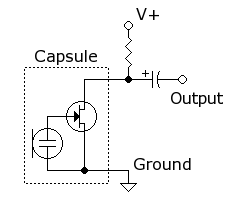
A typical electret microphone preamp circuit uses an FET in a common source configuration. The two-terminal electret capsule contains a FET which must be externally powered by supply voltage V+. The resistor sets the gain and output impedance. The audio signal appears at the output, after a DC-blocking capacitor.


"
<The resistor sets the gain and output impedance.> may be difficult to understand without some electrical knowledge.

This type of Mic is Mechatronics product or Transducer as the condenser part (the left hand circle) is a capacitor (two plates as shown in the symbol) and the capacitance value changes mechanically  according to the change of voice (sound) air pressure, a kind of vibration like a dram surface. Then this capacitance change (containing voice/sound information) is transferred (transduced) through the current change to Voltage change at output (Vout), which transmit to another place (via wire or wireless) and further changes through some amplifier to make a speaker sound.

Capacitor part

V = Q/C

where Q is Charge of Capacitor and C is Capacitance (in Farad).

Q is fixed in case of Electret Condenser Mic so only the change of Capacitance produces the change of Capacitor Voltage accordingly.

C (Capacitance) = e (dielectric constant) x Area (of the plate) / distance (between the two plates)

<e (dielectric constant) x Area (of the plate)> is nearly constant so V changes according to the distance (between the two plates). This distance changes in accordance with the air pressure of voice or sound.

Now let us see JFET.

I checked the specs of several different suppliers like ON Semi (Formally Sanyo product), KEC (Korea), UTC (Taiwan), Jiangsu Changjian (China) - all having <596> and saying <for Electret Condenser Mic) and the specs (Data Sheets) are more or less the same. One spec of 2SK596 (FOSHAN BLUE ROCKET ELECTRONIC, China) shows Z (= impedance).

Zin f=1MHz 25 MΩ
Zo f=1MHz 700 Ω

This spec (available on te net) is very simple (one page spec with no experiment charts) so I cannot check at Zin at lower sound frequency but capacitor impedance usually higher at lower frequencies (less than 1MHz) , zero Frequency - DC impedance infinite or realistically may be some little DC current leak. But Audio frequency is usually 20 to 20,000 Hz (= 0.02MHz).

Wiki <JFET> says

"
A JFET has a large input impedance (sometimes on the order of 1010 ohms)
 
"
1010 ohms = 10,000,000,000 ohms = 10,000MΩ

Another feature is 

Basic features of JFET is (also Wiki)

"
Unlike bipolar transistors, JFETs are exclusively voltage-controlled in that they do not need a biasing current. Electric charge flows through a semiconducting channel between source and drain terminals. By applying a reverse bias voltage to a gate terminal, the channel is "pinched", so that the electric current is impeded or switched off completely.

"
(<By applying a reverse bias voltage to a gate terminal> . This part you recall a PN Junction Diode behavior)

and

"
A JFET is usually ON when there is no voltage between its gate and source terminals. If a potential difference of the proper polarity is applied between its gate and source terminals, the JFET will be more resistive to current flow, which means less current would flow in the channel between the source and drain terminals.

"

<no voltage between its gate and source terminals > can be shown as VGS = 0.

Putting these in your head you can read the spec more meaningful but not enough. See the spec of K596 or 2SK996 or whatever <596>.

ON Semi 2SK596S
20V, 150 to 350uA. 1.0Ms, N-Channel

N-Channel>means Negative Electrons go through Chanel from Source to Drain when apply Voltage called VDS (D+, S-) then "Current" flows from Drain to Source (the current arrow shows this direction)

"
 By applying a reverse bias voltage to a gate terminal, the channel is "pinched"

"

In cease of <N-Channel>the reverse bias voltage is <negative> at Gate to the ground or to Source (VGS) and therefore negative to Drain.
 
The first line of the spec of Absolute Maximum Ratings at 25 Deg C

1. Gate to Drain Voltage   max -20V (this may be Minimum as this is negative value or can be considered as Minus Maximum 20V>)

<Gate to Drain Voltage> is relative voltage since Drain Voltage is normally positive to the ground, and to Source as well (when the current is flowing). But VGD appears only here and no related charts.
When this is more negative than -20 V what will happen ? Some article on FET shows the following <breakdown>  charts.

http://www.learningaboutelectronics.com/Articles/What-is-the-breakdown-voltage-of-a-FET-transistor

What is the Breakdown Voltage, BVDS, of a FET Transistor?

(One article from <Types/Characteristics of JFETs>.)


Breakdown Region of a FET Transistor

This chart (not so accurate but good presentation as a tutorial. This article a not a profissional engineering writing) shows at any VGS Breakdown occurs as VDS increases. 20V seems related but how to relate with the spec of 

Absolute Maximum Ratings at 25 Deg C <Gate to Drain Voltage   max -20V> ?

But this article does explain why and how <breakdown> happens but the story is not so convincing. Why and how <saturation> and <breakdown> happen so regularly as shown in this chart ?

Another explanation

 "


The JFET Breakdown region 

A high voltage at the terminals of JFET transistor can lead to a breakdown through the gate junction. The manufacturer specifications show the breakdown voltage between the drain and the source terminals when the gate and the source terminals are joined. This voltage is known as BVDSS and its value is between 20 and 50 volts. These bias voltages do not have to be greater than these values in order to avoid the deterioration of the device.

"

This refers to  <The manufacturer specifications>but <the breakdown voltage between the drain and the source terminals when the gate and the source terminals are joined. >

<the breakdown voltage between the drain and the source>not <Gate to Drain Voltage >.  But <(when) the gate and the source terminals are joined>which means short, then what happens ?
The chart shows the current is up vertically while the voltage (VDS) remains like Zener Diode. Can be used this phenomenon for some application ?

2. Gate Current (IG) : 10mA max
3. Drain Current (ID) : 1mA max
4. Allowable Power Dissipation: 100mW max

The current and power are relatively small. If these were large JFET will be damaged (but how?)

----ー
Electrical Characteristics at 25 Deg C

1. Gate to Drain Breakdown Voltage      IG 100uA      min -20V

0.1mA (100uA) x 20V = 2mW, which is small. So this breakdown is due to the voltage stress.


2. Cutoff Voltage  VGS(off)     VDS 5V,  ID= 1uA    Typ -0.5V , max -1.0V

This means at VGS = - 0.5 to -1.0V  ID becomes 0 (the current stops). When ID becomes 0 the output voltage becomes high. Please note <A JFET is usually ON when there is no voltage between its gate and source terminals (VGS  = 0).> and when VGS becomes typically -0.5V ID becomes 1uA or less. 
<Condition: VDS 5V,  ID= 1uA> may need some explanation. The experiment chart shows this but cannot see 1uA at VDS 5V. This can be used as a switch function, (voltage control) switch.
A JFET is usually ON    -  the output voltage is low (as the current flows at the output point)
When a JFET is Cutoff    -  the output voltage is high  (as only a very small ID current or no current  flows at the output point).


3. Drain Current  IDSS  VDS 5V, VGS 0V        Rank A   150 - 240uA
                                                                     Rank B   210 - 350uA 


This should be <Saturated Drain Current> IDSS means ID saturated. (Why <ss>?).

IDSS (region) is important for (as) a honest transducer as even VDS increases IDSS remains the same level after passing Vp (Pinch-off VDS) while ID changes according to the change of  VGSas shown in the above chart.

Why and how this (saturation) occurs ?

I found the following explanation (convincing) in the text book I have.

"
IDSS

Conversely if (the) current ceased to flow at the pinch-off, the depletion region would shrank and the current flow would resume. Of course the change is current never actually occurs. ID simply remains at IDSS.

"

A kind of negative feedback reaction or equilibrium mechanism.

Constant current (ID) against the voltage change (in this case VDS) is required for some applications like LED, which is a current operated device. A smaller current - dimmer, larger current brighter, though limited. not only for keeping the constant brightness again change of VDS, a voltage control dimmer is possible by using JFET.


4. Forward Transfer Admittance    |Yfs|      VDS 5V, VGS 0V, f = 1MHz    min 0.4, typ 1.0  mS

This is a bit technical but this is analogous to hHE of Bipolar Tr but not the ration of Corrector I / Base I (no unit). See below.

"
https://www.tek.com/support/faqs/how-do-i-test-jfet-small-signal-forward-transfer-admittance-my-curve-tracer
Small Signal Forward Transfer Admittance - |Yfs|
What It Is:
Small signal forward transfer admittance is the ratio of a change in ID to a change in VGS, with the initial VGS value usually = 0. The (Delta I/ Delta V) ratio is commonly referred to as small signal gain and is given in units of mhos (Siemens).

" 

Please note the condition of 1MHz. 

Anyway <gain is nearly less than 1/1000 Siemens (1mA/1V = 1mS) , no gain. But this is dI/dV so the unit is mS (mili  Siemens). You can see this ID-VGS (with different IDDS, and different temperatutres) Charts in the spec. 

But the above charts do not say <the condition of 1MHz.>. However the spec shows

Chart of  |Yfs|  vs IDDS chart with the condition of VDS=5V, VGS=0V and f = 1MHz.

and  

Chart of  VGS (off) vs IDDS with the condition of VDS=5V, ID = 1uA  
 
5. Input Capacitance  Ciss     VDS 5V, VGS 0V  f = 1MHz   Typ 4.1pF

This is an intrinsic capacitance <measured between the gate and source terminals with the drain shorted to the source of AC signals, made up of the gate to drain Capacitance CGD in parallel with the gate to source Capacitance CGS, or CISS  = CGD  + CGS >

6. Reverse Transfer Capacitance  Crss    VDS 5V, VGS 0V, f = 1MHz   Typ 0.88pF

This is also an intrinsic capacitance <measured between the drain and gate terminals with the source shorted to the ground. This is equal to the gain to drain capacitance.>

5. Input Capacitance and 6. Reverse Transfer Capacitance are much smaller than those of MOSFET due to to the structure difference. This is one of the reasons why JFET is used for Electret Condenser Mic.


"Radioworld" <Design and Performance of Electret Condenser Microphones> (a good article on this issue)
https://www.radioworld.com/news-and-business/design-and-performance-of-electret-condenser-microphones of-electret-condenser-microphones) says:

"
Fig. 8: Low-cost electret condenser microphones almost universally contain a JFET in the capsule. The capacitive electret element has virtually no resistance and a capacitance of only 30 to 80 picofarads. Only a junction field-effect transistor gate has an input resistance high enough to avoid loading down the signal from the condenser element. The JFET source is typically grounded and the drain is pulled up by a resistor (external or internal), resulting in a “phantom bias” on the gate junction. Gain of the JFET is slightly less than unity. EXAMINING LOW-COST ELECTRET TRANSDUCERS
One of the attractions of electret microphones is their low cost. Another is their potentially small size, as shown in Fig. 6 (one in cell phones may be as small as 2 mm in diameter!).
However, the low cost and miniaturization of electret condenser microphones had to wait until the Field Effect Transistor became available (with its extremely high input gate impedance, compared to bipolar transistors) to replace electron-tube impedance converters. The FET allowed Sony (and others) to produce an electret microphone at a price low enough to use with battery-operated recorders.

"

The first bold type part.

"
Only a junction field-effect transistor gate has an input resistance high enough to avoid loading down the signal from the condenser element. 

"

This explains why JFET, not MOSFET, is used for this application. But MOSFET has this property too.


“phantom bias” - What is this ?


Found on the net (Why JFET and not MOSGET for Electret Condenser Mic).

Please see below:
 
https://electronics.stackexchange.com/questions/432504/why-are-the-advantages-of-jfet-over-mosfet-or-why-are-jfet-still-used

The JFET has several advantages over the MOSFET. The most important are:

  • 1) higher gain
  • 2) lower noise
3) These are the overriding factors when building preamplifiers for low-level signals, such as those from microphones.
4) Also, since there's no thin gate oxide that can be punctured by ESD, they're a little more "rugged" in that sense.

5) JFETS have a useful biasing, like a vacuum tube biasing. Simply place a 100 ohm resistor in the Source pin to Ground to control the current, and you can then connect Gate to a DC_conducting sensor such as Moving Coil vinyl-record cartridges and enjoy the JFET response down to DC with no need for DC_blocking capacitors.

DC Bias

https://forum.allaboutcircuits.com/threads/why-electret-microphones-use-jfet.151848/

6 ) The capacitance of the electret part is quite small, and the charge delivered is really tiny. So the device to connect to it must therefore have a very small amount of charge required to produce a useful output. A Jfet is the easiest solution. All of the other options are far more expensive and far less convenient.


----ー

The spec continues.

Voltage gain:
Reduced voltage Characteristic
Frequency Characteristic
Total Harmonic Distortion (THD)
Output Noise Voltage

These are important as these are closely related with the spec of Electret Condenser Mic.


sptt


Thursday, January 30, 2020

China made "cheap" Mobile phone battery chargers


China made mobile phone battery chargers used to be produced mostly in China as did mobile phones. But this becomes a history now. I recently opened some old (no more use) simple AC Adapters used for charging mobile phone battery.

Nokia Model AC-3C

I remember that Switching type very light weight battery chargers (as compared with the conventional heavy Transformer type) were called as "travel charger" including this Nokia model as a heavy Transformer type charger was much heavier to carry than a mobile phone, which seems ridiculous and should have been solved by not paying so much.


Surprisingly simple and light weight.

Switching is made by Transistor 13001 connected to a small and light Transformer. Actually I did this (opening power supplies) because I wanted to know more about Switching Transistors and Switching Transformers and Analog Switches.

Input: 100-240V,  50-60Hz, 35mA
Output: 5V 350mA (DC Plug)

The major function of Transformer is to change Voltage (eventually Current also changed) by winding number differences. But Voltage should not be constant DC but AC or AC like. Here C is for Current but AC (Alternate Current) can be used for Voltage, and can be called as AC Voltage.

<Switching is made by Transistor> means Transistor has a switch(ing) function by supplying or not supplying enough current to Base (by controlling the Base current) to change Collector current (Ic), which changes the output voltage.  

Collector current (Ic) is high  (Transistor works as a conductor) -  Output voltage is low
Collector current (Ic) is low  (Transistor works as a resistor) Output voltage is high  

This sounds like strange but

V = IR

where I is Collector current (Ic) and R is Transistor's R value controlled by Base current). V is not a supply Voltage but "Voltage drop" made by Transistor's R value. Please note that if Ic is very large it may damage or destroy Transistor you must put a resistor between Voltage source and Transistor to limit Ic. This resistor and Transistor's 'Variable Resistor' make 'Voltage Divide'. See below (Wiki: Transistor)


Amplifier circuit, common-emitter configuration with a voltage-divider bias circuit.

"

The above explanation can be found in Transistor Basic Textbooks or Internet Sites in more professional ways. Every part in this schematic has its function but Wiki shows only <voltage-divider bias>. Two Capacitors have their functions too. Two Transistors while two Capacitors and four Resistors are used. This is why so large demands of Capacitors and Resistors in Electronic products.

Back to  Nokia Model AC-3C Spec

Components

T1: Switching Transformer - still the largest
C1:  Input Aluminum Electric Capacitor  3.3uF 400V
C2:  Output Aluminum Electric Capacitor 10uF 100V
C3: Ceramic Disc Capacitor
C4:  Output Aluminum Electric Capacitor 220uF (Voltage cannot seen)
Q1: Switching Transistor 13001
Q2: Transistor C945 (for feedback circuit, connected to Base of Transistor)
ZD1; Zener Diode
D2 1N4007 (1000V 1A) for Input
D3, D4: not found
D5: Glass case Diode
D6: 1N58 (Schottky Diode)
Resistors: R1 - R6

There are no parts on the other side of PCB. No SMT parts and no ICs used. The production cost is supposed to be very low in Shenzhen 15-20 years ago. The label says in Chinese.: Made for Nokia.

ーーーーー

Actually I opened the following Charger first and was surprised how simple it was and wanted to know how it works. This is very similar to the above Nokia model except only one (1) Transistor instead of two (2) while one red indicator LED is used.


Name: TL(brand) Courier Charger, Model TL-888-<IC>
Input: 100-250VAC 50/60 Hz 150mA
Output: 5.0V 1000mA +/-50mA (USB Connector)

Components

Switching Transformer
C1:  Input Aluminum Electric Capacitor  2.2uF 400V
C2: 22uF 25V
C3: 220uF 10V (output)
Ceramic Disc Capacitor (no marking)
Q1: Switching Transistor 13001
D1:Input
ZD1
D2
Resistors: Four
LED (Red)
USB Connector   - big

The component count is less than that of the Nokia model.

How it works ?

I found some good articles or videos for this (How it works.? ) on the net - usually titled "Cheap (China made) battery charger".

Mobile charger circuit diagram, 100-220V AC
https://www.circuitsdiy.com/mobile-charger-circuit-diagram/


The components and their arrangement are very similar to the above <Courier Charger>.  To summarize this article:

Rectifier 1 -  AC input side
Oscillator - including Tr 13001, Switching Trans. Primary and Auxiliary Winding with feedback (to Base of Tr 13001) circuit
Rectifier 2 -  DC output side

Oscillator part is called "Oscillating (Ringing Choke Converter, RCC) flyback Oscillator" and the author estimates Switching 10K -50K cycles/sec - remarkable.


"

Another remarkable thing is that this uses only one Tr 13001, further cost down while it uses a LED for charging indicator.

One more article

DIY RCC SMPS Circuits

https://www.electroschematics.com/diy-rcc-smps-circuits/


-----

I opened some more and they are more complicated, more parts are used so may not be very Cheap though Made in China.


sptt


Monday, May 13, 2019

China made Wireless Speakers - 5


I purchased this even I knew that it did not work, solely for the purpose of checking inside.


I already destroyed four similar no brand (generic) China made Wireless (Bluetooth) Speakers. So I am a bit familiar with the inside.

1. JL or JC logo (highlu likely JL or Jie Li (Technology)

https://www.hkstp.org/en/directory-list/Details/jieli-technology-hong-kong-co-limited

Part No. AC1513CF9J0T. 1- 06BT  -   Bluetooth + MP3 + etc function

I have found this JL brand IC before and introduced in China made Wireless Speakers - 2.

28 pin IC: ACCFCV56.1-07ABT

2. RDA5876 (RDA brand)  -  Bluetooth and FM Radio Chip
 (RDA was purchased by a Chinese company called "Tsinghua Unigroup")

I cannot find radio function in this mini speaker.

I have found this RDA brand IC before and introduced in China made Wireless Speakers - 2.

RDA5876: I found the spec of RDA5876P - SINGLE CHIP FOR BLUETOOTH & FM RADIO TUNE

3. 25080xxxxxx with white paint (this white paint may have some meanings)  - Flash memory

4. KDC8002 - Audio Amp   KDC brand cannot be identified.

5. L 26.000MHz Oscillator

6. One <potentiometer +  switch>  like mechanical device (which seems broken) is connected to this Audio Amp.

7. Slide switch


8.  TF (SD) card connector

9. LED

10. Microphone

11.  4 Ohm 3W speaker

12. Li-Ion Battery  still charged (showing 1.7V) - surprised me.  Then what's wrong with this mini speaker.


ACT


Saturday, April 20, 2019

China made Wireless Speakers - 4


I opened or destroyed  my LED Music Bulb to check the inside. Even after destroying it still works well, making colorful light and sound. The inside is compact, Power supply board, Control board and LED board and speaker. As this is operated by Remote Control no switches are found, which make these compact in addition to using several ICs.


Since the power is AC main like a common bulb it needs to change it to DC.  I know a power supply being important but I skip it this time. Just it uses the following parts:

Switching Power Supply board

1) one Diode Bridge MB8S (On Semi ?)
2) one AC-DC Converter (SPT) SP5626P (Westech Power, China)
3) one Photocoupler CT 357C (CT Micro, China)
4) one relatively big yellow one is a switching transformer with no name
5) one 10uF 400V DC Electrolytic Capacitor (E Cap) (ChengX brand)
6) two 100uF 50V E Caps (ChengX brand)
7) one 22uF 50V E Cap (ChengX brand)
8) one Choke Coil
9) one Diode SF M1C
10) one Film Capacitor 2J102
11) one Metal Oxide Film Resistor
12) two MLCCs
13) several Chip Resistors

Control board 

1) IC  C7THN48129 (1710NRZ-11D) 28-pin Blue tooth and audio, etc function (Brand name (*))
2) FT25H04S (Fremont Micro Devices, China) 4M-bit/2M-bit Serial Flash for program stored
3) 26.000MHz Oscillator
4) ANT8108 SOP8 Audio Amp for the 3W speaker (ShenZhen ChipSourceTek)
5) HXN e2719E (DC-DC Converter) for LED power supply ?
6 ) one SOT89 Transistor D882 (probably SHIKE,China)
7) one 1000uF/10V, one 470uF/10V, one 22uF/50V E Caps (all ChengX brand)
8) one Peaking Coil
9) three SMT (SOT-23) Transistors (S8050 - mark on chip J3Y)
10) many chip resistors and MLCC

(*) The band name is unknown, not identified but I can find this logo on the internet advertisement with similar part numbers.


(After re-checking this logo seems to belong to the company called "AppoTech" and they have some more different rather many Bluetooth + Audio ICs)


ACT

Friday, April 5, 2019

China made Wireless Speakers - 3


This distinctive curvy shape with a speaker protection metal net becomes more distinctive and humorous without the net. The sound quality is not good so I seldom used after purchase. It has FM radio function. It announces by pressing the M(ode) button "Bluetooth mode" , "AUX mode" and "Radio mode" but it has no AUX jack. As the battery has reached its life and Radio Scanning seems to have a problem I opened it without regret.


Inside


 It has the places for two speakers but actually only one real speaker (4 Ohm 3W) and the other is fake or just a vibration plate (orange).


ICs

1) QFP 48p

The part shows a part number like <15190  DSTH509041>. I cannot identify this part on the internet. The green paint on the part may have some meaning.

This logo is also found  in the product introduced in China made Wireless Speakers - 1.

2) 6218 (SOP8)

This is supposed to be RTC6218 (Taiwan Richwave brand) - FM Tuner. The Richwave spec says:

The RTC6218 (RL508) is a single-chip broadcast FM stereo radio tuner with fully integrated building blocks as LNA, VCO with digital synthesizer, digital channel selection filter, digital FM demodulator and MPX decoder. The RL508 integrates the tuner function from antenna input to stereo audio output for worldwide European, US, Japanese and China FM bands. The FM tuner only requires a minimum amount of small and low cost external components to be a very attractive solution for portable devices. With a powerful audio engine, the RL508 is able to deliver optimum sound quality under hostile channel conditions.

3) PV25F04 (SOP8)

Paragon Brand Flash Memory.

4) Audio Amp (SOP 8)

No part number shown or erased naturally or intentionally.


ACT


China made Wireless Speakers - 2


It says - BLUETOOTH  SUPER BASS PORTABLE SPEAKER. This wireless speaker has a good deign and enough heavy weight for staying on a table and has worked well for about three years under very light use (seldom used).  The sound quality is good. But it reached the battery life and no re-charging can be made though it announces "Please charge".  I liked it but decided to open it.


When I purchased this it is bare has no box usually showing technical specifications. The operating side (bottom) shows a very brief spec. It says

Working Voltage 3.7V
Frequency Range:  60Hz -18KHz
Charging Voltage: 5V
Power: 3W


Inside:

1) 28 pin IC: ACCFCV56.1-07ABT

I cannot identify this on the internet. Logo seems <JL> or <JC> (*).

2) RDA5876: I found the spec of RDA5876P - SINGLE CHIP FOR BLUETOOTH & FM RADIO TUNER.

3) (MD BX1511) MD25D80S1G: I found the following on the China internet.
SPI NOR: MD25D80SIG 8Mbit 1MB SOP8

SPI is not the brand name but stands for Serial Peripheral Interface.

4) LTK9902B SOP8 - Audio Amp 3W (same as the previous report ‐China made Wireless Speakers - 1)


I plan to change the battery as I have some stock.

--------

<JL> or <JC> (*)

After re-checking I found <JieLi Ttechnology> use this logo <JL>.
http://www.zh-jieli.com

However, I am not sure right now if the above 28 pin IC: ACCFCV56.1-07ABT belongs to this company or not.


sptt

Thursday, April 4, 2019

China made Wireless Speakers -1


I have many small no brand or generic (highly likely) China made wireless speakers. The one shown in the photos is the best one among them in terms of sound quality. After very light use of about two years it become not to work at all not because of the battery life. So I opened it to see what happened. The PCB is surprisingly small, neat and light in weigh (only 11grams) due to the use of ICs while the others, mostly heavy two speakers and the tough housing combined weigh 350grams, heavy enough to be stable during making sound.


The price tag HK$60 (US$7.70)

The box says

Music Wireless Speaker
MEGABASS
A2DP STEREO

Technical Specifications:

Audio port: TF/USB//AUX
Speaker: Double speakers 4 Ohm 3W, dia 40mm
FM Frequency Range: 87.5- 108MHz
Frequency Response" 100Hz - 16KHz
Battery: 3.7V 1800mAh Lithium battery

It has a microphone as shown in the photo.

ICs inside


1) 28 pin IC AD9N553-31A near the oscillator (JF26.000) and Bluetooth antenna.
I tried but was not able to identify this IC on the internet though I found this logo on some other parts also on the internet.

(I cannot check so I am not sure but probably the problem of no function is due to this IC.)

2) Audio Amp IC: LTK8020D SOP8 (2pcs)

3) Flash Memory: MK25Q40ATIG  SOP8(Miake ? brand)

4) Single Chip Broadcast FM Radio Tuner IC: 5807MS (RDA5807MS)

As I have many small low cost wireless (bluetooth) speakers this title post will continue to find some things.

PCB has a microphone as seen in the photos. It may be used for "hands free" function. Some other more detailed specs are found on the internet like the one shown below.

Specifications:
• Support phone/ laptop/ Tablet PC
• Support USB/TF Card Slot, Support MP3 Format (TF card is not included)
• Modular buddy-jackdesign: connect a row of mini speakers to get jawdraopping audio performance
• Expanded bxs (Bass Expansion system) drives a  fuller, richer low-end response
• New, larger 45mm driver delivers precise high for super sound
• Built-in Microphone
• Built-in FM Radio
• Bluetooth Function
• Hands Free Call Feature
• Rechargeable Lithium Battery
• Audio Devices with 3.5mm Stereo Jack input
• Interface: USB + 3.5 mm audio interface
• Bluetooth version: V2.1
• Operation Range: up to 10m
• Color: Black,red,blue,green,orange.
• Packing: Neutral English box packaging

ACT