Friday, December 13, 2013

Does Alternating Current flow ?

In this post AC means <Alternating Current> unless otherwise mentioned like AC Voltage, which is not <Alternating Current> Voltage but more like <Alternating Voltage>. Let's see the generally accepted idea of AC (Alternating Current).

Alternating current

From Wikipedia, the free encyclopedia (13-Dec-2013)


Alternating Current (green curve). The horizontal axis measures time; the vertical, current or voltage.

In alternating current (AC, also ac), the flow of electric charge periodically reverses direction. In direct current (DC, also dc), the flow of electric charge is only in one direction.
The abbreviations AC and DC are often used to mean simply alternating and direct, as when they modify current or voltage.[1] [2]
AC is the form in which electric power is delivered to businesses and residences. The usual waveform of an AC power circuit is a sine wave. In certain applications, different waveforms are used, such as triangular or square waves. Audio and radio signals carried on electrical wires are also examples of alternating current. In these applications, an important goal is often the recovery of information encoded (or modulated) onto the AC signal.

---- end of quote of this part

If you think for a while about the above explanation on Alternating Current, some simple questions arise.

Question - 1)

"In alternating current (AC, also ac), the flow of electric charge periodically reverses direction."

The direction of AC reverses, which meas the direction changes periodically (back and forth) and usually in very precisely in terms of time - sine wave.

"AC is the form in which electric power is delivered to businesses and residences."

If this be true how electric power is delivered to businesses and residences (seems to one direction, from a power station to businesses and residences) despite AC changes the direction periodically (back and forth).

Question - 2)

"Audio and radio signals carried on electrical wires are also examples of alternating current."

If this be true how Audio and radio signals are carried on electrical wires (seems to one direction, from a radio antenna through electrical wires to a loudspeaker or ear phone) despite AC changes the direction periodically.

We have some answers to Question -2) 

Radio signals (in Electromagnetic Wave form) in space travel far to every direction (all directions), not change direction periodically. You can find more detailed explanations easily but usually with many math equations, which seem very convincing due to the massive math.

But how about  Audio and radio signals on electrical wires after coming into through an antenna? By using DC bias the direction of signals changes from AC (changing direction periodically back and force) to pulsating DC (not changing direction periodically but changing the magnitude periodically). (see the chart at the top)

<wave> may be a hint when considering the direction of AC (Alternating Current)t.

 Additional Question - Direction of time.

I have found few people mentioning this but the direction of the arrow of the horizontal lime indicates that the direction of time is forward not backward. This contradicts the concept of time in our daily life, which is backward. Time is passing through us - from front to back.

-----

Transmission, distribution, and domestic power supply

Wik on AC (13-Dec-2013) continued


AC voltage may be increased or decreased with a transformer. Use of a higher voltage leads to significantly more efficient transmission of power. The power losses in a conductor are a product of the square of the current and the resistance of the conductor, described by the formula
P_{\rm L} = I^2 R \, .
This means that when transmitting a fixed power on a given wire, if the current is doubled, the power loss will be four times greater.
The power transmitted is equal to the product of the current and the voltage (assuming no phase difference); that is,
P_{\rm T} = IV \, .
Thus, the same amount of power can be transmitted with a lower current by increasing the voltage. It is therefore advantageous when transmitting large amounts of power to distribute the power with high voltages (often hundreds of kilovolts).

----- end of quote of this part

Like other explanation on AC (Alternating Current), the story changes to AC Power with the equations and explanation like above  The explanations usually do not mention the direction of AC (Alternating Current). Electrical Power (as well as Electrical Energy) is not a vector quantity but scalar quantity so does not have direction. Transmission means the electrical power is transmitted from one place (power station) to another (to businesses and residences)so it must have one direction.

Effects at high frequencies 

Wik on AC (13-Dec-2013) continued


A direct current flows uniformly throughout the cross-section of a uniform wire. An alternating current of any frequency is forced away from the wire's center, toward its outer surface. This is because the acceleration of an electric charge in an alternating current produces waves of electromagnetic radiation that cancel the propagation of electricity toward the center of materials with high conductivity. This phenomenon is called skin effect.
At very high frequencies the current no longer flows in the wire, but effectively flows on the surface of the wire, within a thickness of a few skin depths. The skin depth is the thickness at which the current density is reduced by 63%. Even at relatively low frequencies used for power transmission (50–60 Hz), non-uniform distribution of current still occurs in sufficiently thick conductors. For example, the skin depth of a copper conductor is approximately 8.57 mm at 60 Hz, so high current conductors are usually hollow to reduce their mass and cost.
Since the current tends to flow in the periphery of conductors, the effective cross-section of the conductor is reduced. This increases the effective AC resistance of the conductor, since resistance is inversely proportional to the cross-sectional area. The AC resistance often is many times higher than the DC resistance, causing a much higher energy loss due to ohmic heating (also called I2R loss).

---- end of quote of this part

"A direct current flows uniformly throughout the cross-section of a uniform wire." As a belief it is OK but some explanation with evidences are required.

"This is because the acceleration of an electric charge in an alternating current produces waves of electromagnetic radiation that cancel the propagation of electricity toward the center of materials with high conductivity. This phenomenon is called skin effect."

This explanation is too simple as no math equations but suggest some important things on our concern the direction of AC (Alternating Current).

The key ward may be again <waves>.

Techniques for reducing AC resistance

Wik on AC (13-Dec-2013) continued

For low to medium frequencies, conductors can be divided into stranded wires, each insulated from one other, and the relative positions of individual strands specially arranged within the conductor bundle. Wire constructed using this technique is called Litz wire. This measure helps to partially mitigate skin effect by forcing more equal current throughout the total cross section of the stranded conductors. Litz wire is used for making high-Q inductors, reducing losses in flexible conductors carrying very high currents at lower frequencies, and in the windings of devices carrying higher radio frequency current (up to hundreds of kilohertz), such as switch-mode power supplies and radio frequency transformers.

 ---- end of quote of this part

The last sentence  (not main clause but subordinate clause) suggests rather implicitly and partly explicitly <wires carry radio frequency current (a kind of AC and current in electromagnetic wave form)> but does not mention the direction of the current but likely a kind of AC - the current changing the direction or magnitude periodically.

Techniques for reducing radiation loss

As written above, an alternating current is made of electric charge under periodic acceleration, which causes radiation of electromagnetic waves. Energy that is radiated is lost. Depending on the frequency, different techniques are used to minimize the loss due to radiation.

 ---- end of quote of this part

The first sentence is very suggestive as an answer to our question <Does Alternating Current flow ?>. What is < periodic acceleration> ? (meanwhile <As written above> is strange as this is never mentioned above>). The explanation is too simple here.

Twisted pairs

At frequencies up to about 1 GHz, pairs of wires are twisted together in a cable, forming a twisted pair. This reduces losses from electromagnetic radiation and inductive coupling. A twisted pair must be used with a balanced signalling system, so that the two wires carry equal but opposite currents. Each wire in a twisted pair radiates a signal, but it is effectively cancelled by radiation from the other wire, resulting in almost no radiation loss.

--- end of quote of this part

This statement suggests <signal current moves back and forth>.

Coaxial cables

Coaxial cables are commonly used at audio frequencies and above for convenience. A coaxial cable has a conductive wire inside a conductive tube, separated by a dielectric layer. The current flowing on the inner conductor is equal and opposite to the current flowing on the inner surface of the tube. The electromagnetic field is thus completely contained within the tube, and (ideally) no energy is lost to radiation or coupling outside the tube. Coaxial cables have acceptably small losses for frequencies up to about 5 GHz. For microwave frequencies greater than 5 GHz, the losses (due mainly to the electrical resistance of the central conductor) become too large, making waveguides a more efficient medium for transmitting energy. Coaxial cables with an air rather than solid dielectric are preferred as they transmit power with lower loss.


 --- end of quote of this part

This explanation also suggests <<signal current moves back and forth>.

Waveguides

Waveguides are similar to coax cables, as both consist of tubes, with the biggest difference being that the waveguide has no inner conductor. Waveguides can have any arbitrary cross section, but rectangular cross sections are the most common. Because waveguides do not have an inner conductor to carry a return current, waveguides cannot deliver energy by means of an electric current, but rather by means of a guided electromagnetic field. Although surface currents do flow on the inner walls of the waveguides, those surface currents do not carry power. Power is carried by the guided electromagnetic fields. The surface currents are set up by the guided electromagnetic fields and have the effect of keeping the fields inside the waveguide and preventing leakage of the fields to the space outside the waveguide.
Waveguides have dimensions comparable to the wavelength of the alternating current to be transmitted, so they are only feasible at microwave frequencies. In addition to this mechanical feasibility, electrical resistance of the non-ideal metals forming the walls of the waveguide cause dissipation of power (surface currents flowing on lossy conductors dissipate power). At higher frequencies, the power lost to this dissipation becomes unacceptably large.

 --- end of quote of this part

This explanation on Waveguide is very suggestive on our concern - again  the direction of AC (Alternating Current).

Fiber optics

At frequencies greater than 200 GHz, waveguide dimensions become impractically small, and the ohmic losses in the waveguide walls become large. Instead, fiber optics, which are a form of dielectric waveguides, can be used. For such frequencies, the concepts of voltages and currents are no longer used.

 --- end of quote of this part

This statement is also very interesting.


Mathematics of AC voltages

Wik on AC (13-Dec-2013) continued

Alternating currents are accompanied (or caused) by alternating voltages. An AC voltage v can be described mathematically as a function of time by the following equation:
v(t)=V_\mathrm{peak}\cdot\sin(\omega t),
where
  • \displaystyle V_{\rm peak} is the peak voltage (unit: volt),
  • \displaystyle\omega is the angular frequency (unit: radians per second)
    • The angular frequency is related to the physical frequency, \displaystyle f (unit = hertz), which represents the number of cycles per second, by the equation \displaystyle\omega = 2\pi f.
  • \displaystyle t is the time (unit: second).
The relationship between voltage and the power delivered is
p(t) = \frac{v^2(t)}{R} where R represents a load resistance.
Rather than using instantaneous power, p(t), it is more practical to use a time averaged power (where the averaging is performed over any integer number of cycles). Therefore, AC voltage is often expressed as a root mean square (RMS) value, written as V_{\rm rms}, because
P_{\rm time~averaged} = \frac{{V^2}_{\rm rms}}{R}.
---- End of quote

These equations remind us

The power losses in a conductor are a product of the square of the current and the resistance of the conductor, described by the formula
P_{\rm L} = I^2 R \, .


 This equation is relatively easy to understand intuitively as the current flows (sorry for using <flow> here through resistor, which use power. But
P_{\rm time~averaged} = \frac{{V^2}_{\rm rms}}{R}.

 is unti-intuitive as V is generally potential. But when we consider that voltage and the unit of voltage - volt (s) are defined as

Voltage = Energy / Charge. 1 volt = 1 Joule / 1 coulomb

 Energy comes in.

Anyway among the Wiki explanation on AC we cannot find any explicit explanation on our concern - the direction of AC (Alternating Current). So we must continue to seek.

--------

My very old Penguin dictionary of Electronics (printed in 1980) simply explains

in <wave>

An alternating current propagated through  a long chain of network or filter behaves as if it were wave. Elementary particles, such as electrons, have associated wavelike characteristics. See also Doppler effect.

I think the word <to propagate> is more appropriate than <to flow> when to show the direction of Alternating Current.


ACT


Sunday, December 8, 2013

VQ = Energy, VI = P


VQ = Energy

The above equation is not so often seen as P (Power) = VI. As Energy is P x time, and I = Q (Charge) / time

VQ ---> V x I x time ---> P x time ---> Energy

So the equation is correct and very simple or even elegant. But what does VQ mean ?

VQ is mathematically V times Q or V multiplied by Q or the product of V and Q. But in terms of Physics VQ may have some meaning.

I is the time ratio of Q, time is related so dynamic while Q itself is not, and electrical quantity. If V is static (no change with time) this Energy (VQ) is static too or we could say potential. And Energy is scalar not a vector quantity.

We could say

P (Power) = VI (and P x time = Energy) is dynamic as far as V or I or both change with time while VQ = Energy is static as far as V does not change with time.

VQ is also regarded as Work. Penguin Dictionary of Physics explain:

"
work  Symbol W; unit: joule.

4. If a charge Q is displaced between two points with potential difference U the work done electrically is QU. The unit of potential difference, the volt, is so defined that if work is in joules and charge in coulobms, then U is volts.

"

But I think that work is more like a definition than a meaningful physical property. Is energy simply a definition too?

We can make a simple modification of the equation VQ = Energy, we can get

V = Energy / Q, or

Voltage is Energy per Charge.


ACT


Monday, December 2, 2013

Electric Energy Transfer in AC form


This post is a continuation of the last past <What really AC (Alternate Current) and Power are ?>.

Electric Energy - wiki (05-Dec-2013)

Electrical energy is energy newly derived from electrical potential energy. When loosely used to describe energy absorbed or delivered by an electrical circuit (for example, one provided by an electric power utility) "electrical energy" refers to energy which has been converted from electrical potential energy. This energy is supplied by the combination of electric current and electrical potential that is delivered by the circuit. At the point that this electrical potential energy has been converted to another type of energy, it ceases to be electrical potential energy. Thus, all electrical energy is potential energy before it is delivered to the end-use. Once converted from potential energy, electrical energy can always be described as another type of energy (heat, light, motion, etc.).

words by words 

<newly> -  may indicate some sense of time and have special meaning but can be deleted with no significant difference. 
This energy is supplied by the combination of electric current and electrical potential
By using a formula this can be express electric current (I) and electrical potential (V), ie, I x V = Power. And Energy = Power x Time.
<this electrical potential energy has been converted to another type of energy, it ceases to be electrical potential energy.>

Now back to the last post


We then consider the resistor as the resistance value of the the whole system of the right hand side. This whole system may consist of  several actual Resistors, Capacitors, Inductors, Diodes, Transistor, ICs, etc and consume Electrical Power or Energy (Energy is Power x Time) to do something for you. Now we consider the power consumed by this one system Resistor.

Power = I x V
                                                                                                               
You may know that in terms of Power AC or DC does not matter as
P = I^2 R = \frac{V^2}{R},

<At the point that this electrical potential energy has been converted to another type of energy, it ceases to be electrical potential energy.>

<At the point> - what point ?
this electrical potential energy> - what does <this> mean ?

< all electrical energy is potential energy before it is delivered to the end-use.>

 These statements seem to contradict <return path> in the last post as all the potential energy seem to be consumed in the circuit.

All (or some) returns ? or only one way and never return ? Which is correct ? Both are wrong.

Consider the amount of current at 1)  the (2nd winding ) upper line (as hot wire) and 2) the center tap wire (as the neutral wire), the current must be the same. I = V/R.  Even when V or R or both change (which is common) I at the above two locations (more precisely at the same points) always the same or more precisely become the same instantly and continuously.

Again, 

Still a big question remains - how actually and exactly Electrical Energy is transferred from a power station to a household in a big picture and how Energy (reached a household) is transferred from the inlet to the power consuming home appliance(s) in a small picture? Either in a big picture or small picture the basic behavior of Electric Energy Transfer may be the same.

Introduction of Electromagnetic Filed

Electromagnetic Filed - wiki (05-Dec-2013)

Electromagnetic field as a feedback loop- wiki

The behavior of the electromagnetic field can be resolved into four different parts of a loop:
  • the electric and magnetic fields are generated by electric charges,
  • the electric and magnetic fields interact with each other,
  • the electric and magnetic fields produce forces on electric charges,
  • the electric charges move in space.
A common misunderstanding is that (a) the quanta of the fields act in the same manner as (b) the charged particles that generate the fields. In our everyday world, charged particles, such as electrons, move slowly through matter, typically on the order of a few inches (or centimeters) per second[citation needed], but fields propagate at the speed of light - approximately 300 thousand kilometers (or 186 thousand miles) a second. The mundane speed difference between charged particles and field quanta is on the order of one to a million, more or less. Maxwell's equations relate (a) the presence and movement of charged particles with (b) the generation of fields. Those fields can then affect the force on, and can then move other slowly moving charged particles. Charged particles can move at relativistic speeds nearing field propagation speeds, but, as Einstein showed[citation needed], this requires enormous field energies, which are not present in our everyday experiences with electricity, magnetism, matter, and time and space.
The feedback loop can be summarized in a list, including phenomena belonging to each part of the loop:
  • charged particles generate electric and magnetic fields
  • the fields interact with each other
    • changing electric field acts like a current, generating 'vortex' of magnetic field
    • Faraday induction: changing magnetic field induces (negative) vortex of electric field
    • Lenz's law: negative feedback loop between electric and magnetic fields
  • fields act upon particles
    • Lorentz force: force due to electromagnetic field
      • electric force: same direction as electric field
      • magnetic force: perpendicular both to magnetic field and to velocity of charge
  • particles move
    • current is movement of particles
  • particles generate more electric and magnetic fields; cycle repeats

The underline is made by me. I have found some articles mentioning this misunderstanding but most of them do not show satisfactory "correct" understanding. The feedback theory of this wiki explanation is also not so satisfactory (or rather confusing to me) and did not say anything about AC, which is actually used in our daily lives.

1) charged particles, such as electrons, move slowly through matter, typically on the order of a few inches (or centimeters) per second[citation needed]  

You can find some citations in some websites.

Speed of electricity - Wiki (05-Dec-2013)

Electric drift
 
The drift velocity deals with the average velocity that a particle, such as an electron, gets due to an electric field. In general, an electron will 'rattle around' in a conductor at the Fermi velocity randomly.[3] Free electrons in a conductor vibrate randomly, but without the presence of an electric field there is no net velocity. When a DC voltage is applied the electrons will increase in speed proportional to the strength of the electric field. These speeds are on the order of millimeters per hour. AC voltages cause no net movement; the electrons oscillate back and forth in response to the alternating electric field.[4]


Propagation Times
http://www.ultracad.com/articles/propagationtime.pdf

Speed of Electricity
http://www.cartage.org.lb/en/themes/sciences/physics/Electromagnetism/Electrostatics/ElectricCurrent/Mysteryofelectric/Mysteryofelectric.htm


2) Maxwell's equations relate (a) the presence and movement of charged particles with (b) the generation of fields.

This is a big issue and complicated too. At least you master Gradient, Divergence and Curl to some extent.

Maxwell's Equations - wiki (05-Dec-2013)

Maxwell's equations describe how electric and magnetic fields are generated and altered by each other and by charges and currents.

The equations have two major variants. The "microscopic" set of Maxwell's equations uses total charge and total current, including the complicated charges and currents in materials at the atomic scale; it has universal applicability, but may be unfeasible to calculate. The "macroscopic" set of Maxwell's equations defines two new auxiliary fields that describe large-scale behavior without having to consider these atomic scale details, but it requires the use of parameters characterizing the electromagnetic properties of the relevant materials.

(Simple summary:  The Maxwell's equations have two major variants - "microscopic"and "macroscopic")

Vector calculus formalism

Throughout this article, symbols in bold represent vector quantities, and symbols in italics represent scalar quantities, unless otherwise indicated.
To describe electromagnetism in the powerful language of vector calculus, the Lorentz force law defines the electric field E, a vector field, and the magnetic field B, a pseudovector field, where each generally have time-dependence. The sources of these fields are electric charges and electric currents, which can be expressed as the total amounts of electric charge Q and current I within a region of space, or as local densities of these - namely charge density ρ and current density J.
In this language there are four equations. Two of them describe how the fields vary in space due to sources, if any; electric fields emanating from electric charges in Gauss's law, and magnetic fields as closed field lines not due to magnetic monopoles in Gauss's law for magnetism. The other two describe how the fields "circulate" around their respective sources; the magnetic field "circulates" around electric currents and time varying electric fields in Ampère's law with Maxwell's correction, while the electric field "circulates" around time varying magnetic fields in Faraday's law.

(Simple summary:  the electric field E - source - electric charges and the  magnetic field B - source - electric currents ((each generally have time-dependence)), which can be expressed as the total amounts of electric charge Q and current I within a region of space, or as local densities of these - namely charge density ρ and current density J.)

(Please note that Power and Energy (Power x Time) are scalar and The E and B fields are vectors. And Maxwell's equations are vector equations)

Conventional formulation in SI units  - "microscopic"

Name Integral equations Differential equations
Gauss's law \oiint{\scriptstyle\partial \Omega }\mathbf{E}\cdot\mathrm{d}\mathbf{S} = \frac{1}{\varepsilon_0} \iiint_\Omega \rho \,\mathrm{d}V \nabla \cdot \mathbf{E} = \frac {\rho} {\varepsilon_0}
Gauss's law for magnetism \oiint{\scriptstyle \partial \Omega }\mathbf{B}\cdot\mathrm{d}\mathbf{S} = 0 \nabla \cdot \mathbf{B} = 0
Maxwell–Faraday equation (Faraday's law of induction) \oint_{\partial \Sigma} \mathbf{E} \cdot \mathrm{d}\boldsymbol{\ell}  = - \frac{d}{dt} \iint_{\Sigma} \mathbf{B} \cdot \mathrm{d}\mathbf{S} \nabla \times \mathbf{E} = -\frac{\partial \mathbf{B}} {\partial t}
Ampère's circuital law (with Maxwell's correction) \oint_{\partial \Sigma} \mathbf{B} \cdot \mathrm{d}\boldsymbol{\ell} = \mu_0 \iint_{\Sigma} \left(\mathbf{J} + \varepsilon_0 \frac{\partial \mathbf E}{\partial t} \right)\cdot \mathrm{d}\mathbf{S} \nabla \times \mathbf{B} = \mu_0\left(\mathbf{J} + \varepsilon_0 \frac{\partial \mathbf{E}} {\partial t} \right)
There are universal constants appearing in the equations; in this case the permittivity of free space ε0 and the permeability of free space μ0, a general characteristic of fundamental field equations.
In the differential equations, a local description of the fields, the nabla symbol ∇ denotes the three-dimensional gradient operator, and from it ∇· is the divergence operator and ∇× the curl operator. The sources are taken to be as local densities of charge and current.
In the integral equations; a description of the fields within a region of space, Ω is any fixed volume with boundary surface ∂Ω, and Σ is any fixed open surface with boundary curve ∂Σ. Here "fixed" means the volume or surface do not change in time. Although it is possible to formulate Maxwell's equations with time-dependent surfaces and volumes, this is not actually necessary: the equations are correct and complete with time-independent surfaces. The sources are correspondingly the total amounts of charge and current within these volumes and surfaces, found by integration. The volume integral of the total charge density ρ over any fixed volume Ω is the total electric charge contained in Ω:
Q = \iiint_\Omega \rho \, \mathrm{d}V\,,
and the net electrical current is the surface integral of the electric current density J, passing through any open fixed surface Σ:
I = \iint_{\Sigma} \mathbf{J} \cdot \mathrm{d} \mathbf{S}\,,
where dS denotes the differential vector element of surface area S normal to surface Σ. (Vector area is also denoted by A rather than S, but this conflicts with the magnetic potential, a separate vector field).
The "total charge or current" refers to including free and bound charges, or free and bound currents. These are used in the macroscopic formulation below.

--- end of quote

Let's take one by one (but only differential equations)

\nabla \cdot \mathbf{E} = \frac {\rho} {\varepsilon_0}

(Gauss's Law)

This equation states the relation between E (Electric field) and Charges under the conditions of  "microscopic", static (not dynamic related with time) and vacuum (permittivity of free space ε0)  The conditions are not very realistic, far from AC (the value changing with time). Anyway, we go on.

The right hand side is the divergence of E (Electric field). Since the divergence is the (3-dimesional) differentiation we see what is happening at a certain point (each or every point) of E (Electric field) and in terms of vector. As E (Electric field) is (a vector of the collection of ) every point vector the result becomes a scalar, So the right hand side should also scalar.

The right hand side is charge density ρ divided by permittivity of free space ε0. What does this mean ?

Charge desity = Cherges / Volume (3D). Q/V(Volume). In this case a very small volume (an infinitesimal volume). Charge is very small so we can count them even in an infinitesimal volume. The unit is Coulomb / m3 (cubic).

Permitivity. A bit difficult to understand.

Permitivity- wiki (05-Dec-2013)

In electromagnetism, absolute permittivity is the measure of the resistance that is encountered when forming an electric field in a medium. In other words, permittivity is a measure of how an electric field affects, and is affected by, a dielectric medium. The permittivity of a medium describes how much electric field (more correctly, flux) is 'generated' per unit charge in that medium. More electric flux exists in a medium with a high permittivity (per unit charge) because of polarization effects.

---- end of quote

<the measure of the resistance that is encountered when forming an electric field in a medium>.

The resistance here is like an inertia against status quo. To change the mechanical status que you need something like force. In the case of permitivity something should be additional voltage difference.

<The permittivity of a medium describes how much electric field (more correctly, flux) is 'generated' per unit charge in that medium.>

In this case <a medium> is vacuum (free space). <per unit charge> is very microscopic and this relates with  charge density ρ of the right hand side of the equation.

Or we could say

(Permittivity is the electric flux density in a body divided by the Electric Field strength (E) which created the flux. It is the quantity of a mediam that allows it (the medium) to store a Electric field (Energy ?))

< (more technically, flux)>

Does <more technically> have any special meaning, here ?

Electric flux is not a flow of charges (which is current). To understand the meaning of the right had side of the equation (or Maxwell's Equations in general) we need to know the concept of Electric flux - fictitious but having the unit (volt metres (V m)).

Electric flux - wiki (05-Dec-2013)

In electromagnetism, electric flux is the rate of flow of the electric field through a given area (*1). Electric flux is proportional to the number of electric field lines (*2) going through a virtual surface. If the electric field is uniform, the electric flux passing through a surface of vector area S is
\Phi_E = \mathbf{E} \cdot \mathbf{S} = ES \cos \theta,
where E is the electric field (having the unit of V/m), E is its magnitude, S is the area of the surface, and θ is the angle between the electric field lines and the normal (perpendicular) to S. For a non-uniform electric field, the electric flux dΦE through a small surface area dS is given by
d\Phi_E = \mathbf{E} \cdot d\mathbf{S}
(the electric field, E, multiplied by the component of area perpendicular to the field). The electric flux over a surface S is therefore given by the surface integral:
\Phi_E = \iint_S \mathbf{E} \cdot d\mathbf{S}

where E is the electric field and dS is a differential area on the closed surface S with an outward facing surface normal defining its direction.
For a closed Gaussian surface, electric flux is given by:
\Phi_E =\,\!\oiint\scriptstyle S\mathbf{E}\cdot d\mathbf{S} = \frac{Q}{\epsilon_0}\,\!
where
E is the electric field,
S is any closed surface,
Q is the total electric charge inside the surface S,
ε0 is the electric constant (a universal constant, also called the "permittivity of free space") (ε0 ≈ 8.854 187 817... x 10−12 farads per meter (F·m−1)).
This relation is known as Gauss' law for electric field in its integral form and it is one of the four Maxwell's equations.

It is important to note that while the electric flux is not affected by charges that are not within the closed surface, the net electric field, E, in the Gauss' Law equation, can be affected by charges that lie outside the closed surface. While Gauss' Law holds for all situations, it is only useful for "by hand" calculations when high degrees of symmetry exist in the electric field. Examples include spherical and cylindrical symmetry.
Electrical flux has SI units of volt metres (V m), or, equivalently, newton meters squared per coulomb (N m2 C−1). Thus, the SI base units of electric flux are kg·m3·s−3·A−1.
Its dimensional formula is [L3MT–1I–1].

--- end of quote

(*1) Electric flux is the rate of flow of the electric field through a given area.

This is wrong as "flux" is not a flow (despite the name) and so not the rate of flow either. Electric flux is static presence of the electric field through a given area. However it reminds us of the definition of electric current - the rate of flow of the charges through a given area.

(*2) as the field line is fictitious the number of field lines is also fictitious.

\Phi_E =\,\!\oiint\scriptstyle S\mathbf{E}\cdot d\mathbf{S} = \frac{Q}{\epsilon_0}\,\!

You can see Q/ε0 in the right hand side of this equation, similar to the right hand side of our original equation

\nabla \cdot \mathbf{E} = \frac {\rho} {\varepsilon_0}

where  charge density ρ. Q is the total electric charge inside the surface S (i.e. the total Charges in a volume, not a small volume as this is an integral equation while our original equation is a differential one.


  ------

Let's look at the following Capacitor equation.

I(t) = C \frac{\mathrm{d}V(t)}{\mathrm{d}t}.
When the voltage over a capacitor (across the two plates) does not change with time the derivative is zero so I is zero. We can think of a special time when a non-charged capacitor becomes charged only once (the voltage do not change after it is fully charged). Now the derivative is not zero so during this special period I changes with time too, that is, the current flows. Please note that in this case (capacitor equation with I and V) I (the does not relate with the value of V but the rate change of V with time.

Meanwhile we can use this equation as checking the electrical units.

Permittivity of a capacitor (of vacuum)

C = \frac{\varepsilon A}{d}
A = Area of one of the two plates of a capacitor (the area of the both plates are considered to be equal and exactly face to face at 90 deg.)
d = distance of the two plate

So unit wise

C =   ε x m x m / m --->   ε x  m

therefore

ε  = C / m

Meanwhile from the equation

I(t) = C \frac{\mathrm{d}V(t)}{\mathrm{d}t}.


I = CV/t  ----> Q/t = CV/t   ---->   Q = CV

So  C = Q /V

To put into ε  = C / m

ε  = Q / Vm

 The 1st Maxwell's equation of differential form is

\nabla \cdot \mathbf{E} = \frac {\rho} {\varepsilon_0}

where ρ is Charge density, Q / m x m x m

so the right hand side becomes

Q / m x m x m
----------------          ---> V / m x m
Q / Vm (in vacuum)

and the left hand side is a differentiation of E (Electric Field vector) in 3D space so the unit is also V / m x m. So unit wise the Maxwell's equation is correct. But what does this mean ?

Charge density (ρ)  is in a way the strength of Charges and the more Charges per unit volume the stronger. ε is a value of Q / Vm, which indicates the ration of Q to Vm - how many Charges per Vm, or the relation between Q and Vm. If Vm is constant the higher ε  the more Charges.

Vm is Electric Flux.


ACT


Friday, November 29, 2013

What really AC (Alternate Current) and Power are ?


You may face some confusion when reading AC (Alternate Current) things in basic Electronic or Electric writings. As unlike water current we cannot see actual movements of Electrical Current(s) we must believe what the writer says. But most writers of the writings on AC (Alternate Current) things are not quite sure of it by themselves, I assume, or taking it for granted (the readers already know it).

For instance

Ground and neutral - wiki

This article needs additional citations for verification. Please help improve this article by adding citations to reliable sources. Unsourced material may be challenged and removed. (September 2012) 


As the neutral point of an electrical supply system is often connected to earth ground, ground and neutral are closely related. Under certain conditions, a conductor used to connect to a system neutral is also used for grounding (earthing) of equipment and structures. Current carried on a grounding conductor can result in objectionable or dangerous voltages appearing on equipment enclosures, so the installation of grounding conductors and neutral conductors is carefully defined in electrical regulations. Where a neutral conductor is used also to connect equipment enclosures to earth, care must be taken that the neutral conductor never rises to a high voltage with respect to local ground.

Contents

Definitions

Ground or earth in a mains (AC power) electrical wiring system is a conductor that provides a low impedance path to the earth to prevent hazardous voltages from appearing on equipment (the terms "ground" (North American practice) and "earth" (most other English-speaking countries) are used synonymously here). Under normal conditions, a grounding conductor does not carry current.
Neutral is a circuit conductor that carries current in normal operation, which is connected to ground (or earth).
In a polyphase or three-wire (single-phase) AC system, the neutral conductor is intended to have similar voltages to each of the other circuit conductors. By this definition, a circuit must have at least three wires for one to serve as a neutral.

-----

Mains electricity - Wiki


Mains electricity is the general-purpose alternating-current (AC) electric power supply.
:
:

Building wiring

In most countries, household power is single-phase electric power, with two or three wired contacts at each outlet.
  • The live wire (also known as phase, hot or active contact), carries alternating current between the power grid and the household.
  • The neutral wire completes the electrical circuit by also carrying alternating current between the power grid and the household. The neutral is connected to the ground, and therefore has nearly the same electrical potential as the earth. This prevents the power circuits from increasing beyond earth voltage, such as when they are struck by lightning or become otherwise charged.
  • The earth wire or ground connects the chassis of equipment to earth ground as a protection against faults (electric shock), such as if the insulation on a "hot" wire becomes damaged and the bare wire comes into contact with the metal chassis or case of the equipment.

----

Wiki itself notices that the above two articles are not good stuff. Let us take some better descriptions.

From: http://www.dummies.com/how-to/content/alternating-current-in-electronics-hot-neutral-and.html

Alternating Current in Electronics: Hot, Neutral, and Ground Wires

Before you start working with line voltage in your electronic circuits, you need to understand a few details about how most residential and commercial buildings are wired. The following description applies only to the United States; if you’re in a different country, you’ll need to determine the standards for your country’s wiring.
Standard line voltage wiring in the United States is done with plastic-sheathed cables, which usually have three conductors. This type of cable is technically called NMB cable, but most electricians refer to it using its most popular brand name, Romex.
image0.jpg Two of the conductors in NMB cable are covered with plastic insulation (one white, the other black). The third conductor is bare copper. These conductors are designated as follows:
  • Hot: The black wire is the hot wire, which provides a 120 VAC current source.
  • Neutral: The white wire is called the neutral wire. It provides the return path for the current provided by the hot wire. The neutral wire is connected to an earth ground.
  • Ground: The bare wire is called the ground wire. Like the neutral wire, the ground wire is also connected to an earth ground. However, the neutral and ground wires serve two distinct purposes.
    The neutral wire forms a part of the live circuit along with the hot wire. In contrast, the ground wire is connected to any metal parts in an appliance such as a microwave oven or coffee pot. This is a safety feature, in case the hot or neutral wires somehow come in contact with metal parts.
    Connecting the metal parts to earth ground eliminates the shock hazard in the event of a short circuit.
Note that some circuits require a fourth conductor. When a fourth conductor is used, it's covered with red insulation and is also a hot wire.
The three wires in a standard NMB cable are connected to the three prongs of a standard electrical outlet (properly called a receptacle). As you can see, the neutral and hot wires are connected to the two vertical prongs at the top of the receptacle (neutral on the left, hot on the right) and the ground wire is connected to the round prong at the bottom of the receptacle.
image1.jpg You can plug a two-prong or three-prong plug into a standard three-prong receptacle. Two-prong plugs are designed for appliances that don't require grounding.
Most nongrounded appliances are double-insulated, which means that there are two layers of insulation between any live wires and any metal parts within the appliance. The first layer is the insulation on the wire itself; the second is usually in the form of a plastic case that isolates the live wiring from other metal parts.
Three-prong plugs are for appliances that require the ground connection for safety. Most appliances that use a metal chassis require a separate ground connection.
There is only one way to insert a three-prong plug into a three-prong receptacle. But regular two-prong plugs, which lack the ground prong, can be connected with either prong on the hot side.
To prevent that from happening, the receptacles are polarized, which means that the neutral prong is wider than the hot prong. Thus, there's only one way to plug a polarized plug into a polarized receptacle. That way, you can always keep track of which wire is hot and which is neutral.

-----

The underlines made by me.

  • Hot: The black wire is the hot wire, which provides a 120 VAC current source.
  • Neutral: The white wire is called the neutral wire. It provides the return path for the current provided by the hot wire. The neutral wire is connected to an earth ground.

These explanations on AC (as we are not talking about Ground so I omit it ) are very common. You can find them through internet easily. You will try as I did.

But when you consider the AC (Alternate Current) nature it is very strange that <the hot wire, which provides a 120 VAC current (source)> and < the neutral wire. It provides the return path for the current provided by the hot wire.> as AC changes its direction with time regularly (sinusoidouslly) as the rate of 50/60Hz / second. So what do <xxx provides a 120 VAC current (source)> and <xxx return path for the current> mean? If we talk about DC sourced by a battery (batteries) the explanation seems more reasonable as DC has only one fixed direction all the time.

Let's be back to very basic things.

From: http://hyperphysics.phy-astr.gsu.edu/hbase/electric/hsehld.html

Household Wiring


The standard U.S. household wiring design has two 120 volt "hot" wires and a neutral which is at ground potential. The two 120 volt wires are obtained by grounding the center tap of the transformer supplying the house so that when one hot wire is swinging positive with respect to ground, the other is swinging negative. This versatile design allows the use of either hot wire to supply the standard 120 volt household circuits. For higher power applications like clothes dryers, electric ranges, air conditioners, etc. , both hot wires can be used to produce a 240 volt circuit.

-----

Please read the above explanation and see carefully the transformer part.


Center Tap (Transformer) - Wiki 
:
:
: 
Common applications of center-tapped transformers


  • A full-wave rectifier using two diodes and a center tap transformer.

    The above is the typical rectifier circuit by using center-tapped transformer.

    The sine wave is misleading as the horizontal line is time, If you think the place at the top of the secondary winding, at the left side of D1 the voltage change 0 -> + peak -> 0 and then -> - peak -> 0 periodically.

    Meanwhile If you think the place at the bottom of the secondary winding, at the left side of D2 the voltage change 0 -> - peak -> 0 and then -> + peak -> 0 periodically.
    Then the above right hand picture showing the upper part of hr sine waves .

     
    We neglect the two diodes and get


Please regard 120V as 240V and 60V as 120V (actually any voltages will do for principal explanation as far as the ratio is correct. And then think about the only one circuit the (2nd winding) upper line (as hot wire) and the center tap wire (as the neutral wire) and neglect the lower line (hot line) shown in the above drawing of hyperphysics as well.

We then consider the resistor as the resistance value of the the whole system of the right hand side. This whole system may consist of several actual Resistors, Capacitors, Inductors, Diodes, Transistor, ICs, etc and consume Electrical Power (Energy) to do something for you. Now we consider the power consumed by this one system Resistor.

Power = I x V
                                                                                                               
You may know that in terms of Power AC or DC does not matter as
P = I^2 R = \frac{V^2}{R},


Next, or I would like to say "finally", you think about what is happening on the upper and center tap points of the secondary winding of the transformer. Again we cannot see them (can see by using oscilloscope but still this is not really happening there as the horizontal line of the oscilloscope screen is time) but guess it. It may not be the current "provided" (pushed out) at the point of upper point and not "return" (pulled in, pushed in) at the point of the center tap continuously as the current is AC = Alternate Current.

Still a big question remains - how actually and exactly Electrical Energy is transferred from a power station to a household in a big picture and how Energy (reached a household) is transferred from the inlet to the power consuming home appliance(s) in a small picture? Either in a big picture or small picture the basic behavior of Electric Energy may be the same.


ACT


Friday, June 21, 2013

Reciprocal


Reciprocal is somehow anti-intuitive. y = x is a very simple function, a simple straight line but its reciprocal : y = 1/x is not simple at all as shown below.

(Note: y = 1/x. This can be changed to yx = 1. also think of a rectangular having area 1 (fixed) and one side y , the other side x. Think about the meaning of this.)


Ohm's Law

         V
I =  ------
         R (in Ohm)


Ohm's Law shows a simple relation between I (current), V(voltage) and R(Resistance). When V is fixed, the relation between I and R becomes simply reciprocal. Say, to make V = 1 (volt), it becomes

         1
I =  ------
         R


When R is very large, say 1M ohm ( 1,000,000 ohm) and 1G ohm (1,000,000, 000 ohm), the current differs very little from 1/1,000,0000 A (1uA) to 1/1,000,000,000 (1 nano A), much less than 1mA and much far less than 1A. Analogically if you a resistor your effort to increase from 1M ohm to 1G ohm (1,000 times higher) will very little rewarded as the current decreases only by 1 / 1000 or 0.999 uA.

On the other hand,  when R is small (not very small), say from 1 ohm to 0.1 ohm (differs only 0.9 ohm), the current changes from 1A to 10A (fairy large current). If  R is 0.1 Ohm and  0.01 Ohm, the difference is only 0.09 Ohm but the current increases from 10A to 100A (huge current), which will make a common consumer use battery die in a very short period. Again analogically if you a resistor and you decrease (yourself) from 1 ohm to 0.01 ohm (only by 0.99 ohm) you will get a big reward of 100A from 1A.

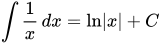
This relates with the following fundamentally very important relation is

\int {1 \over x}\,dx=\ln \left|x\right|+C

Ref

y = sin (1/x)

The graph of this relation becomes

Picture 1

Copy from https://samjshah.com/2009/10/03/sin1x/

This article is easy to read.

The sine function has the max value 1 (one) and the minimum value is -1 (minus one) but the cycle becomes extremely frequent as x reaches 0 (zero), which the chart cannot show.

<to becomes extremely frequent>can be expressed as <to become more frequent exponentially>. Reciprocal and exponential may have some relations.


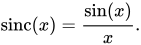
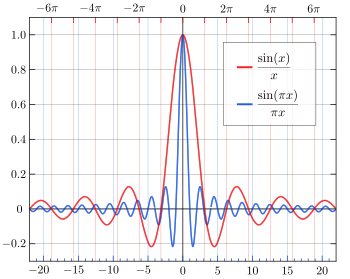
Looks similar but different - sinc function (wiki)


{\displaystyle \operatorname {sinc} (x)={\frac {\sin(x)}{x}}.}


Another Ref


R, C, L Circuits

In Parallel Circuit of Resistors and Inductors (Coils) and the Series Circuit of Capacitors we can find reciprocals. Simple one is a Parallel Circuit of Resistors. The conclusion is

The Reciprocal of the total resistance = the sum of the Reciprocal of each Resistance.


Generally 

IT  =  I1 + I2 + I3.

I = V/R

Therefore

VT/RT V1/R1 + V2/R2 + V3/R3

Since VT =  V1 = V2 = V3

Therefore 1/RT  = 1/R1 + 1/R2 + 1/R3

Intuitively to bundle or twist the three wires together more current flows in them than the current flow in one single wire. But why <The Reciprocal of the total resistance = the sum of the Reciprocal of each Resistance> ?  we need the above calculation. And remember <The total resistance is not the sum of the Reciprocal of each Resistance> but <The Reciprocal of the total resistance is the sum of the Reciprocal of each Resistance>, I would say double Reciprocal.

Not RT  = 1/1 Ohm + 1/10 Ohm  + 1/100 Ohm   = 111/100 Ohm

But 

1/RT  = 1/1 Ohm + 1/10 Ohm  + 1/100 Ohm   = 111/100 Ohm

RT  = 100/111 Ohm  (Less than 100 Ohm)

I would say "Double Reciprocal " as  we usually calculate like

                        1
RT  =   -----------------------------
              1/R1 + 1/R2 + 1/R3

And I think many people do this though some strangeness remains.
 

Contrary to the Parallel arrangement Series Circuit is straight forward or very simple. The total Resistance = the sum of each Resistance.


R = R1 + R2 + R3 + ...


Generally 

VT  = V1 + V2 +V3.

IR = V

Therefore

ITRT I1R1 + I2R2 + I3R3

Since IT =  I1 = I2 = I3


Therefore  RT  = R1 + R2 + R3


Inductors act like resistors as XL (which is regarded as resistance) = 2πfL. On the other and Capacitors act as reciprocal of Resistors as XC (which is regarded as resistance) = 1/2πfC


More interesting reciprocal nature will be found in the combination of  RC, RL, LC and LCR Circuits, which I will review later.


ACT